


Whitney Economics and the Global Cannabis Network Collective (GCNC) have published a new report confirming that severe cannabis price compression is an inevitable phase of legalization. This dynamic, observed across the U.S., Canada, and Germany, directly stems from operators and regulators consistently underestimating supply capacity during early market development.
The report, titled “What You Need to Know: Pricing Compression and Its Impact on International Cannabis Markets,” draws on extensive market data and operator perspectives from multiple continents. It utilizes a predictive modeling framework adapted from logistics economics to forecast how pricing behaves at each stage of market development.
The core argument is a fundamental reframe of the industry's narrative. Falling prices are not a symptom of a broken industry. Instead, they represent a predictable phase of market maturation. The problem arises when regulators focus exclusively on controlling demand and access, while operators build long-term business plans based on inflated early-stage pricing.
According to Beau Whitney, founder and chief economist at Whitney Economics, pricing patterns remain remarkably consistent regardless of how a specific market evolves. "The operators and investors that perform best are typically the ones using data to anticipate where the market is heading, rather than reacting after margins are already under pressure," he noted in the report.
New markets characteristically launch with constrained supply, elevated prices, and high investor optimism. However, Whitney Economics’ modeling shows that within three to seven years, supply capacity inevitably outpaces demand. This triggers annual price declines of 10% to 20% before prices eventually stabilize closer to the actual cost of production.
In the United States, the data paints a stark picture of oversupply. Authorized supply capacity across U.S. legal markets currently equals roughly 600% of legal demand, and 225% of total demand (including the illicit market). Consequently, only 27.3% of cannabis operators were profitable in 2024, compared to the 65% profitability rate of standard U.S. small businesses.
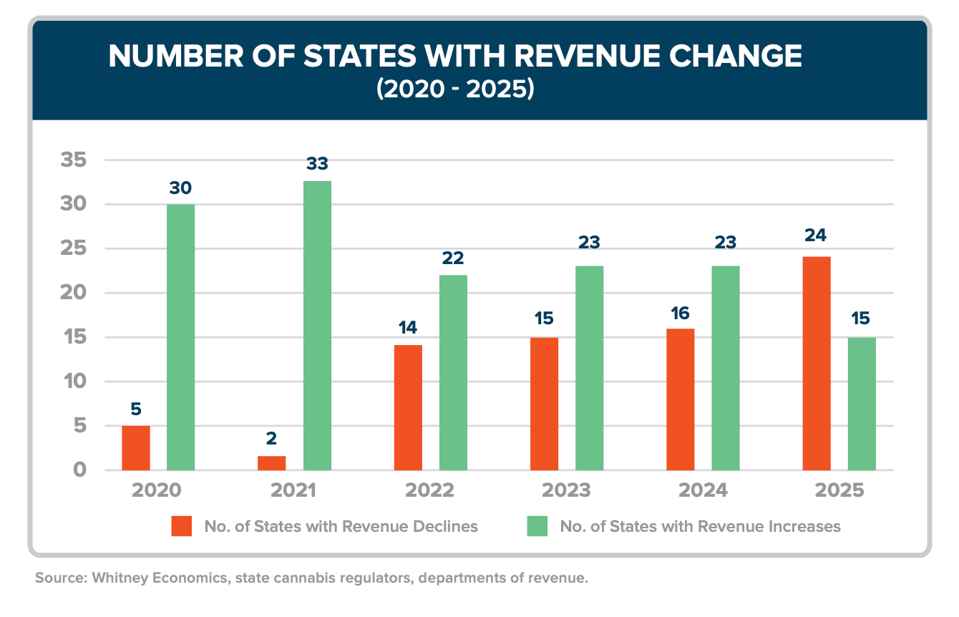
This financial strain is compounding. A delinquent payments report estimated the industry carried $3.8 billion in unpaid debts as of 2023. By 2025, U.S. legal cannabis revenues fell to between $28.6 billion and $29.6 billion—down from $30.1 billion in 2024. This marks the first revenue contraction in the history of the regulated U.S. market, with an estimated 24 states experiencing declining revenues.
Canada serves as the most thoroughly documented cautionary tale. Following federal adult-use legalization in 2018, licensed producers aggressively built supply capacity, partially in anticipation of a U.S. federal legalization that never materialized. By April 2020, producers held over 600,000 kilograms of unsold unpackaged cannabis.
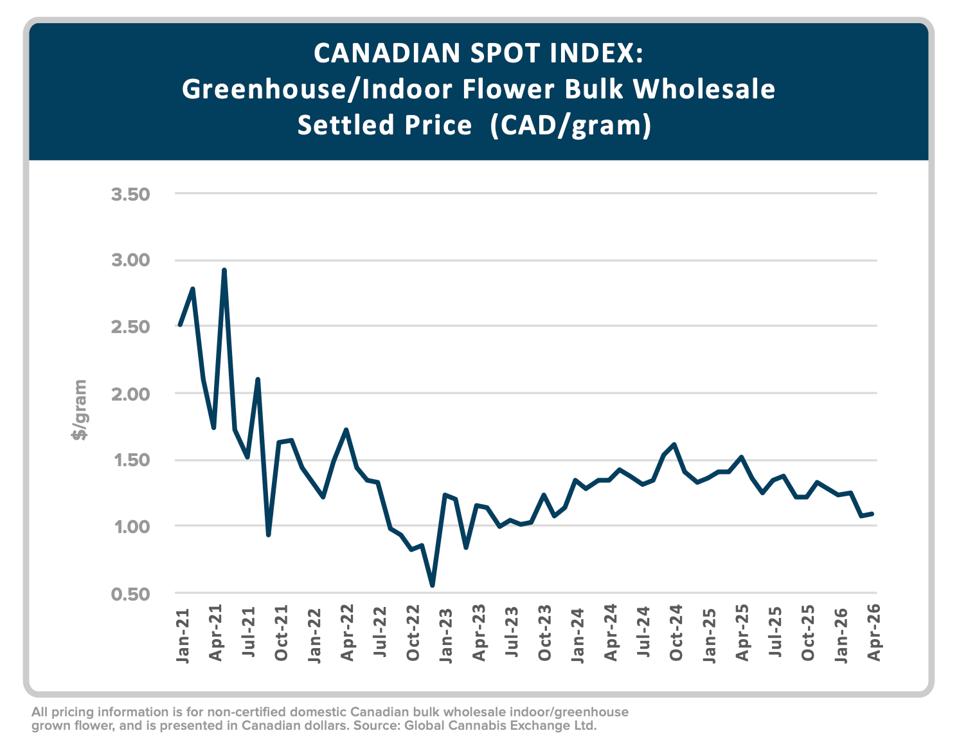
The fallout in Canada was severe. In 2021, producers destroyed more than 425 million grams of unpackaged dried cannabis, representing 26% of total production. Between 2022 and early 2024, over 42 cannabis-related companies filed for insolvency. Canadian wholesale flower prices plummeted nearly 50% between January 2021 and December 2025.
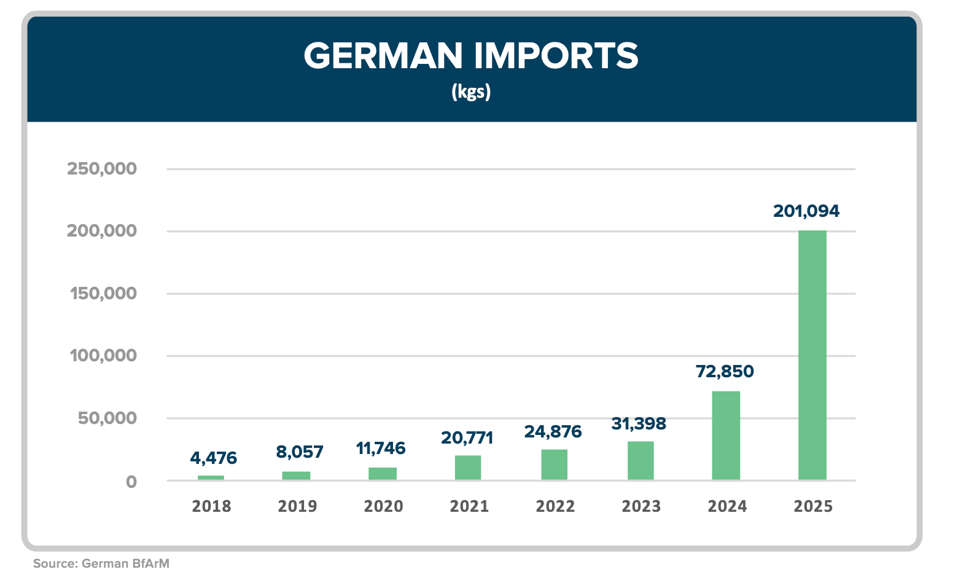
Germany currently represents the most active case study for international investors. The April 2024 Cannabis Act removed cannabis from the narcotics framework, enabling telemedical prescribing and mail-order dispensing. This created a rapid new patient channel, causing imports to surge from 4,476 kilograms in 2018 to an estimated 201,094 kilograms in 2025.
The German market now possesses enough import supply to support up to one million consumers, despite having an estimated 700,000 to 900,000 actual patients. This imbalance has resulted in a price decline of approximately 25% in two and a half years, with lowest pharmacy retail prices approaching four euros per gram.
| Market | Supply & Demand Imbalance | Impact on Pricing & Industry |
|---|---|---|
| United States | Authorized supply is 600% of legal demand. | First-ever revenue contraction in 2025; only 27.3% of operators profitable in 2024. |
| Canada | Massive overproduction post-2018 legalization. | 425M grams destroyed in 2021; wholesale prices fell ~50% by Dec 2025; 42+ insolvencies. |
| Germany | Imports surged to 201,094 kg in 2025, outpacing patient count. | Prices dropped ~25% in 2.5 years; retail prices approaching €4 per gram. |
Aleksandra Vujinovic, founder of AV Legal, highlighted how quickly the German market transitioned. "As reimbursement structures and access pathways evolved, the market shifted quickly from scarcity-driven pricing to competitive pricing pressure," she stated, noting the immediate impact on operational planning.
Germany's trajectory faces further regulatory hurdles. A proposed government amendment, which passed its first parliamentary reading in December 2025, aims to ban telemedical initial prescriptions and mail-order dispensing. This uncertainty is a new market condition operators must now price into their models.
The report emphasizes that cannabis pricing follows an S-curve: slow declines early on, rapid compression during expansion, and eventual stabilization as weaker operators exit. By modeling this arc, businesses can adjust their cost structures proactively.
Not all markets suffer severe compression. Missouri has maintained stable pricing since 2023 through controlled licensing, keeping supply and demand balanced. Similarly, Switzerland's pharma-centric medical model utilizes strict entry standards to preserve pricing stability, proving that the severity of compression is largely a policy choice.
Jillian Reddish, co-founder of GCNC, stated the report is designed to provide a "clearer line of sight into how markets evolve" and what operators should monitor before expanding. Ultimately, the data offers a roadmap: early-stage pricing is merely the starting line, and price compression is a sign of a maturing, rather than broken, industry.
